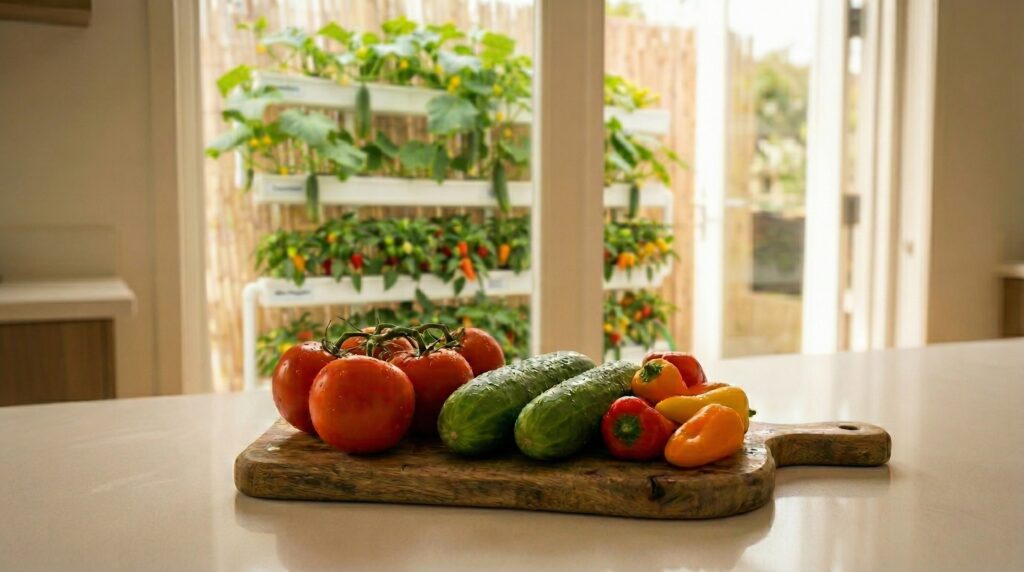
Growing Fruiting Vegetables Hydroponically: What You Need to Know Before You Start

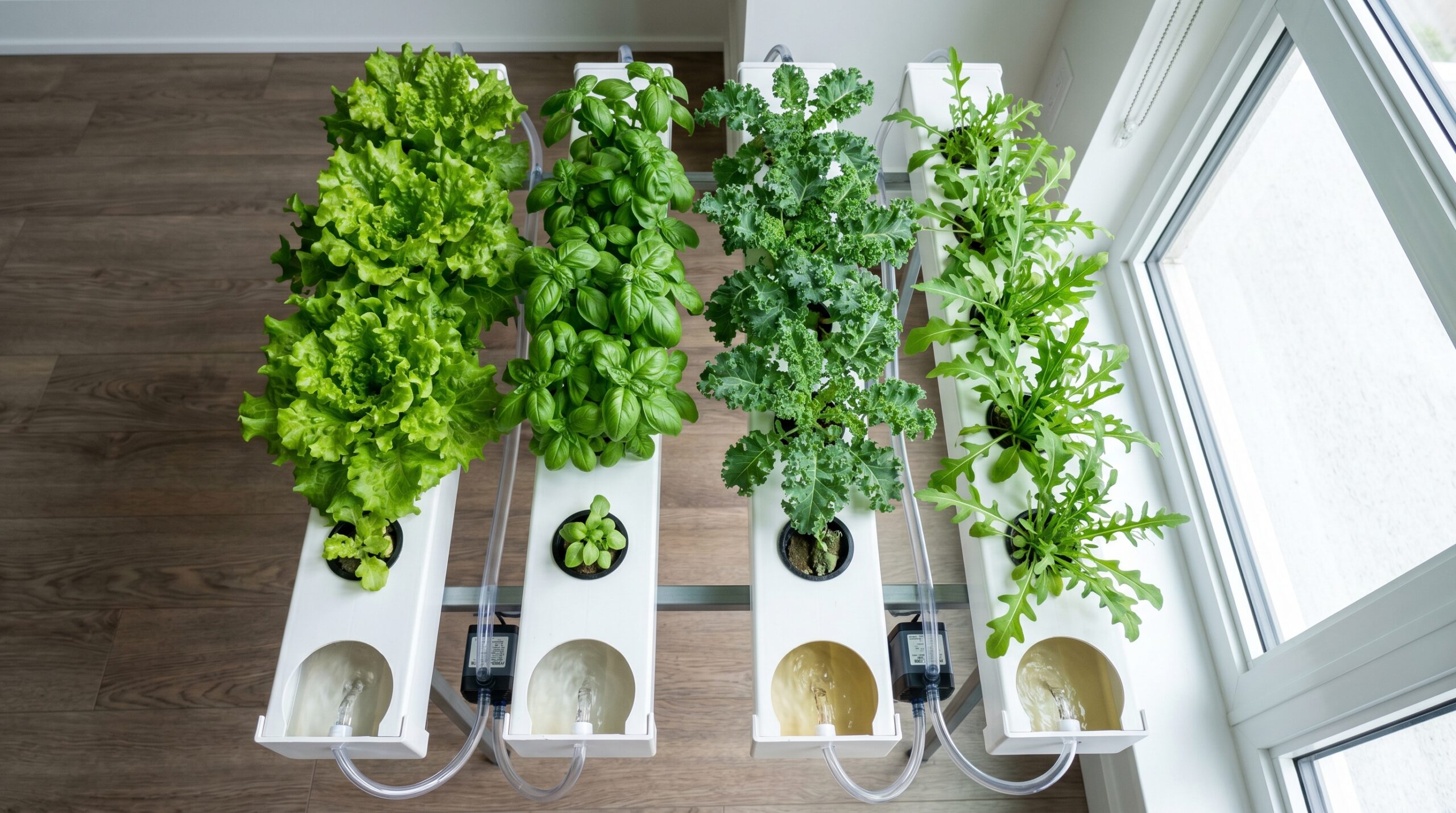
Growing lettuce and herbs hydroponically is one thing. Growing tomatoes, peppers, and cucumbers is something else entirely.
Not harder, but different. Fruiting vegetables have their own set of rules, and growers who skip over them end up with the same frustrating result: beautiful, leafy plants that barely produce any fruit. Leaves everywhere, flowers everywhere, tomatoes nowhere.
The reason is straightforward. Fruiting crops need more from you and from the system. This guide covers exactly what those differences are and how to handle each one.
If you’re thinking about growing food that actually fruits (tomatoes, peppers, cucumbers, eggplants, zucchini, beans, strawberries), this article covers what makes them different from leafy greens and what you need to do about it. (And if you’re wondering: broccoli and cauliflower belong in this category too. They don’t fruit in the traditional sense, but they take just as long to mature, need just as much space, and have the same requirements. Everything here applies to them.)
Why fruiting vegetables are a different game
Leafy greens are simple. They grow leaves. That’s their whole job. You give them light, water, nutrients, and they give you food. The cycle is short, the demands are modest, and the margin for error is wide.
Fruiting vegetables have a longer, more complex lifecycle. They start by growing leaves and roots (the vegetative stage), then they shift to producing flowers, and then those flowers need to become fruit. Each stage has its own requirements. If you treat a tomato plant like a lettuce plant, you’ll get a very green, very leafy, very fruitless tomato plant.
The key differences come down to six things: roots, light, nutrients, pH, pollination, and support. Let’s go through each one.
They need more room for roots
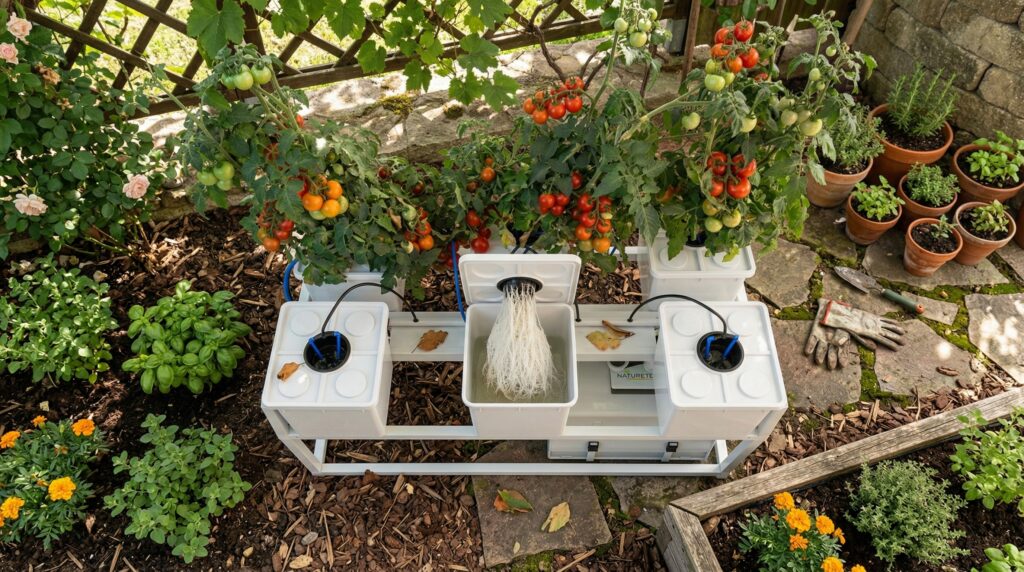
This is the first thing most beginners overlook. Lettuce has a compact, tidy root system that fits comfortably in a small net pot. A tomato plant’s roots are aggressive. They spread wide, grow thick, and after a few weeks they can fill an entire channel or container.
If your system uses narrow channels (anything under about 4 inches / 100mm in diameter), fruiting vegetables will clog them. The roots block water flow, the nutrient solution can’t circulate, and you end up with leaks and starving plants. It’s the most common mismatch in home hydroponics: someone buys a system designed for lettuce and tries to grow tomatoes in it.
For fruiting crops, you want either wide channels with removable lids (so you can access and trim roots when needed), or individual containers like Dutch Buckets where each plant gets its own generous root zone. The more room you give the roots, the bigger and more productive the plant above will be.
They need more light. A lot more.
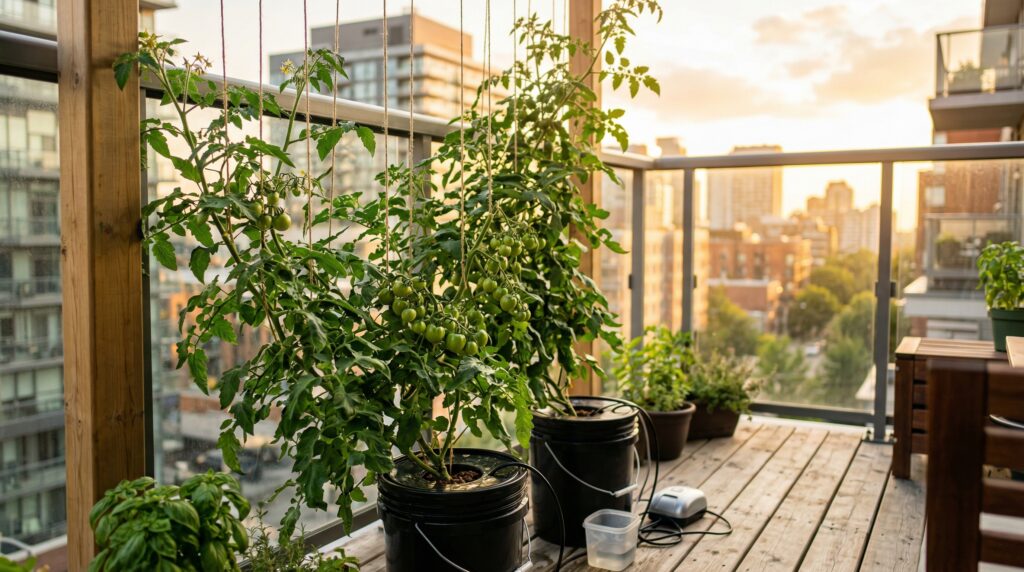
Lettuce can get by with 10 to 12 hours of moderate light. Fruiting vegetables need 14 to 16 hours of strong, full-spectrum light to produce well. They need that intensity not just to grow, but to power the energy-intensive process of turning flowers into fruit.
If you’re growing outdoors, this is usually not a problem. A south-facing balcony or patio in most of the US gets plenty of sun from spring through fall. In hot climates like the southern US, the Southwest, or the Mediterranean (where summer days are long and intense), sun is abundant, but heat management becomes the challenge (more on that below).
Indoor growing requires serious lighting. A windowsill won’t cut it for tomatoes. You’ll need grow lights, and not the small ones. Look for full-spectrum LEDs rated for flowering and fruiting plants. Plan to run them 14 to 16 hours a day. The electricity cost is real, so it’s worth factoring in before you plant.
One more thing about light: fruiting plants get tall. Tomatoes can easily reach 5 to 6 feet, and cucumbers vine aggressively. Your light source needs to be adjustable, because the distance between the light and the top of the plant matters a lot.
Their nutritional needs change as they grow
This is the single most important thing to understand about fruiting vegetables in hydroponics, and it’s the one most beginners get wrong.
During the vegetative stage (the first few weeks, when the plant is building leaves and stems), fruiting vegetables need more nitrogen. This is the same nutrient profile that works for leafy greens.
Once the plant starts flowering, the requirements shift. Now it needs more phosphorus and potassium to support flower development and fruit production. If you keep feeding it the same vegetative-stage nutrients, you’ll get a huge, bushy plant that keeps growing leaves instead of fruit. The plant is doing exactly what you’re telling it to do: grow green stuff.
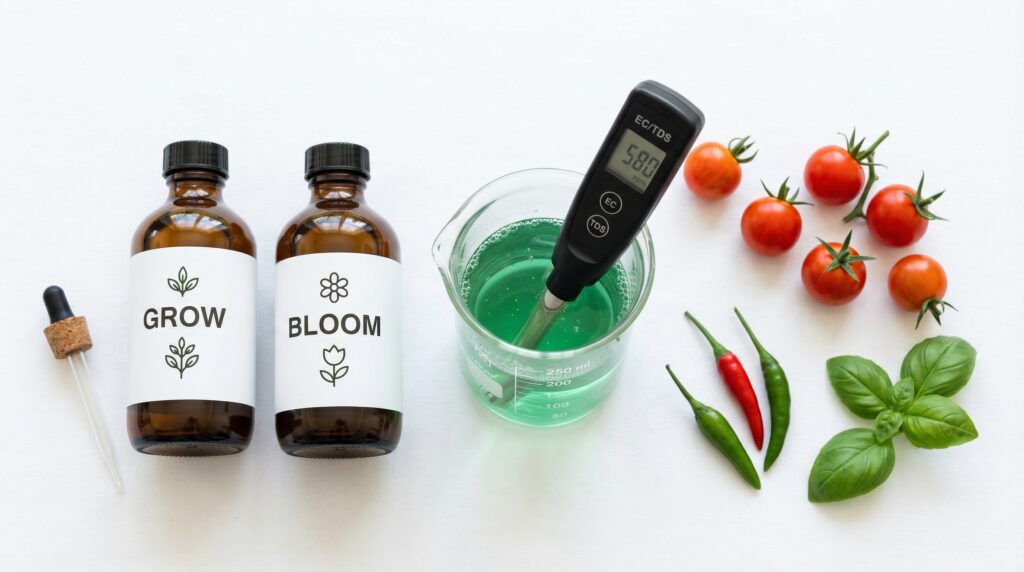
The fix is straightforward. When you see the first flowers appear, switch to a nutrient formula designed for fruiting or flowering. Most hydroponic nutrient brands offer a “bloom” or “fruit” formula alongside their standard “grow” formula. The transition doesn’t need to be dramatic: just start using the flowering mix and adjust over a few days.
A few numbers to keep in mind:
During vegetative growth, keep your EC (electrical conductivity) between 1.5 and 2.5. During fruiting, you can push it up to 2.5 to 3.5 for tomatoes and peppers, sometimes even higher. Cucumbers prefer to stay a bit lower, around 2.0 to 2.5.
And always, always add calcium and magnesium. Fruiting plants are heavy feeders of both. A calcium deficiency in tomatoes shows up as blossom end rot: that ugly, dark, sunken spot on the bottom of the fruit. It looks like a disease, but it’s just the plant telling you it’s not getting enough calcium. A Cal-Mag supplement prevents this entirely.
pH: the five minutes that make everything else work
You can have perfect nutrients in your reservoir, but if the pH is off, your plants can’t access them. It’s like locking food behind a door and losing the key.
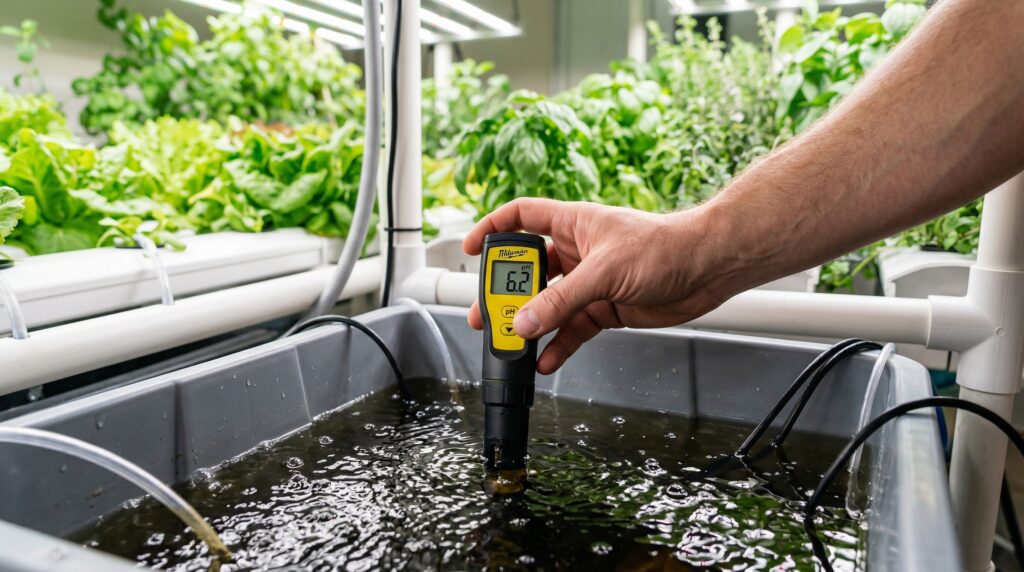
Fruiting vegetables need their nutrient solution pH between 5.5 and 6.5. Most tap water starts higher than that, and nutrients shift the pH when you add them. So after every nutrient adjustment, you need to check and correct the pH.
The routine is simple: mix your nutrients, wait a few minutes for the solution to stabilize, test the pH with a liquid test kit or digital pen, and add a small amount of pH-down (or pH-up) solution until you’re in range. The whole thing takes about five minutes. Do it once a week, right after you adjust your nutrients, and your plants will have access to everything they need.
If you skip this step, you may notice yellowing leaves or slow growth even though you’re feeding correctly. The food is there, the plants just can’t reach it.
Combined with nutrients, your weekly maintenance for fruiting vegetables comes down to about 10 minutes: 5 minutes adjusting nutrients, 5 minutes balancing pH. That’s the real commitment. Everything else is occasional.
Pollination: not just an indoor problem
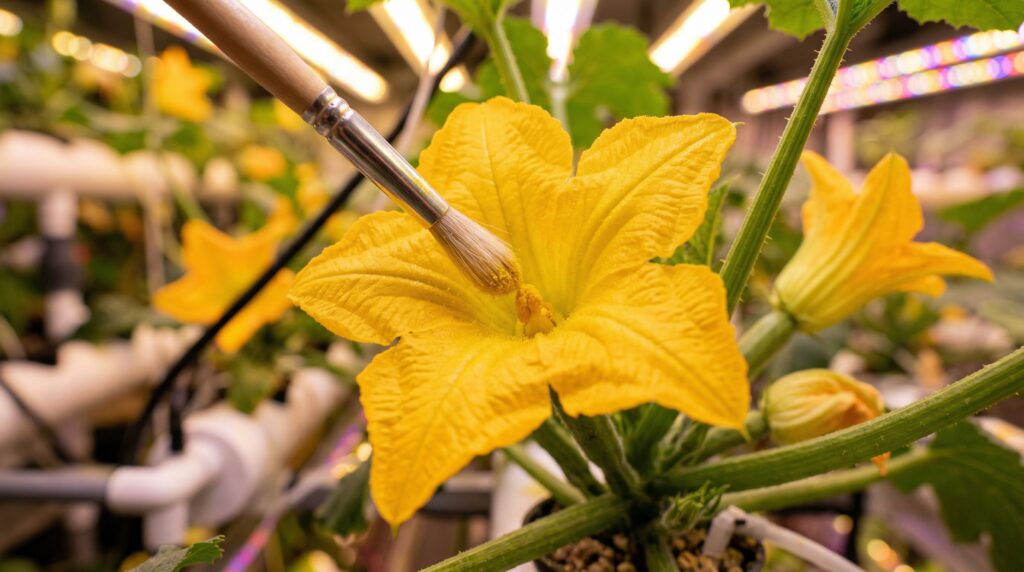
This is the step many growers overlook entirely, and it costs them a significant portion of their harvest.
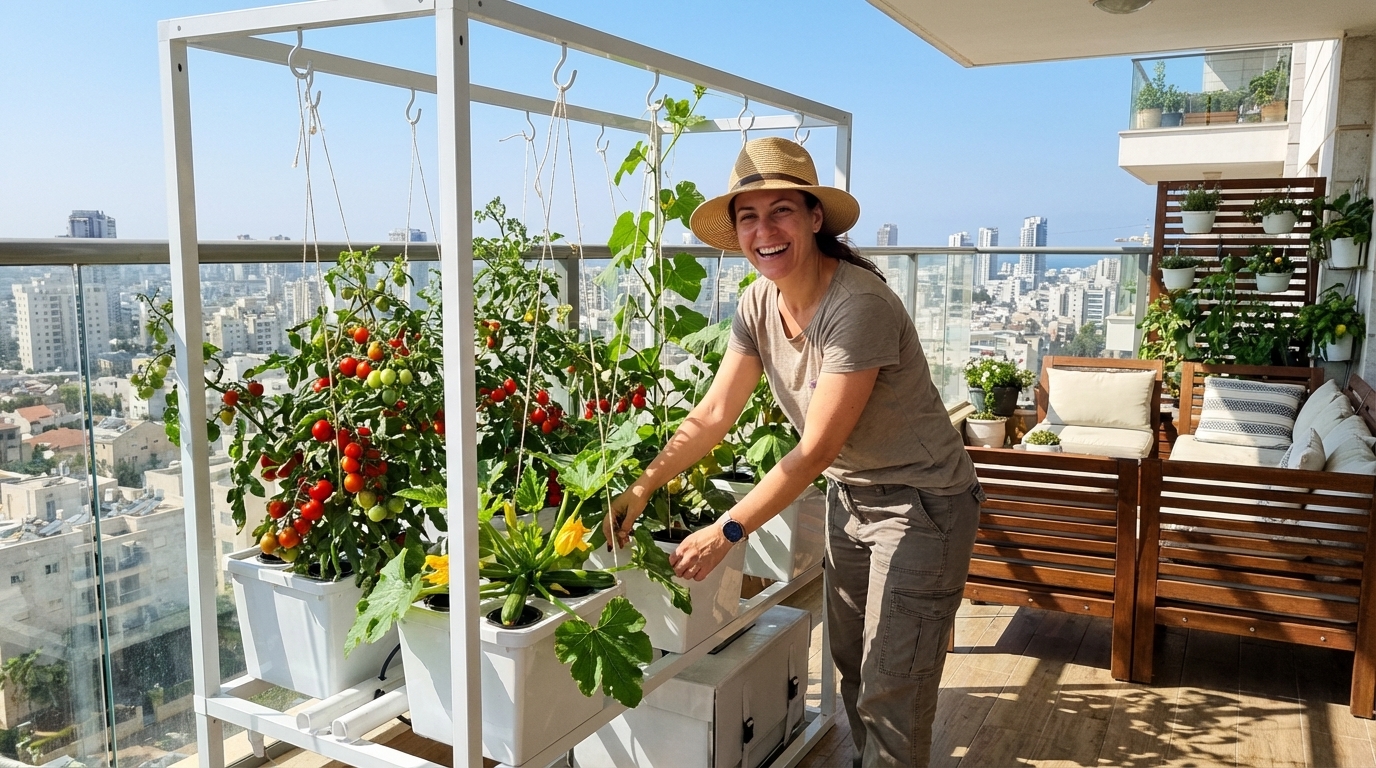
Indoors, there is no wind and there are no bees. Without intervention, flowers bloom and drop without producing fruit. But the problem isn’t limited to indoor growing. Urban balconies, rooftops, and patios often have very few natural pollinators. Bees and other insects are far less common in dense city environments than in suburban or rural areas. Growers in apartments and urban homes routinely report flowers that open, look healthy, and fall off without setting fruit.
This is especially common with cucumbers, zucchini, and squash. Unlike tomatoes and peppers (which are self-pollinating, meaning pollen moves within the same flower), these crops produce separate male and female flowers on the same plant. Pollen must physically travel from a male flower to a female flower for fruit to develop. Without bees or strong wind to carry it, that transfer simply doesn’t happen on its own in most urban settings. The result: the small fruit behind the female flower yellows, shrivels, and drops. It’s not disease. It’s unfertilized flowers.
Tomatoes and peppers are easier in this regard. Each flower contains both male and female parts. The pollen just needs to be shaken loose inside the flower. But even with self-pollinating crops, manual assistance increases fruit set significantly, especially in sheltered or low-wind environments.
Bottom line: if you’re growing fruiting vegetables in a city, on a balcony, under a covered porch, or indoors, plan on doing manual pollination as part of your routine.
Four effective methods, each taking about two minutes:
Gentle shaking. Give the flower cluster a light tap or shake. This mimics wind and moves pollen inside the flower. Do this once a day when flowers are open. Effective for tomatoes and peppers.
A small fan. A gentle breeze from a clip-on fan pointed at the plants creates enough air movement to shake pollen loose. This also helps with stem strength and air circulation.
A cotton swab or small paintbrush. Essential for cucumbers, zucchini, and squash. Gently collect pollen from inside a male flower (the one without a small fruit behind it), then transfer it to the center of a female flower (the one with the small swelling at its base). Move from male to female, and repeat across the plant. This is exactly what a bee does.
An electric toothbrush. Unconventional, but remarkably effective for self-pollinating crops like tomatoes and peppers. Hold the vibrating toothbrush against the flower stem (not the flower itself) for a few seconds. The vibration shakes pollen loose and improves fruit set rates substantially.
They need physical support
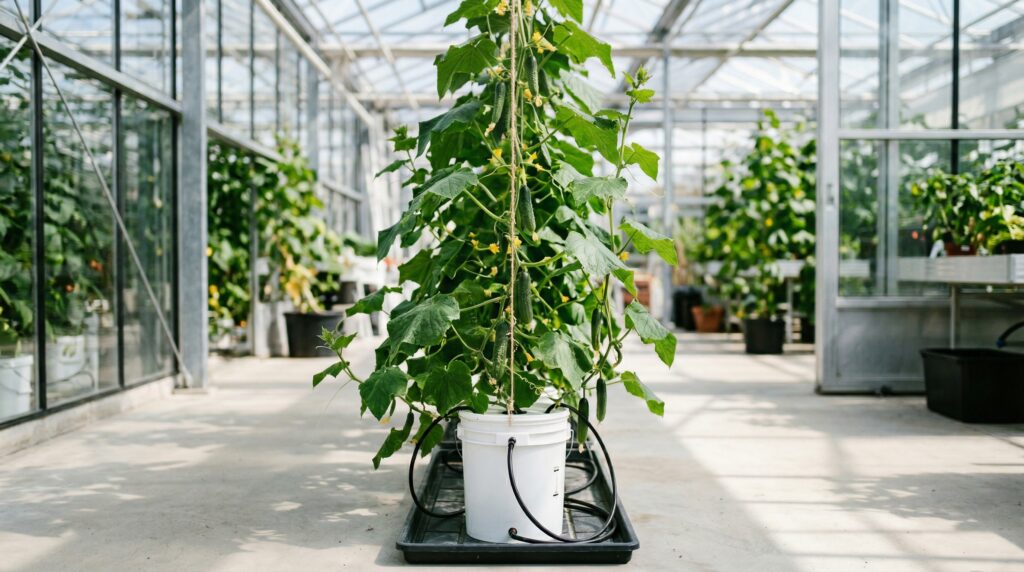
Lettuce sits politely in its net pot and doesn’t ask for much. Tomatoes are not polite. They grow tall, they grow heavy, and once they start producing fruit, the weight can snap branches or pull the entire plant down.
Every fruiting vegetable needs some form of support:
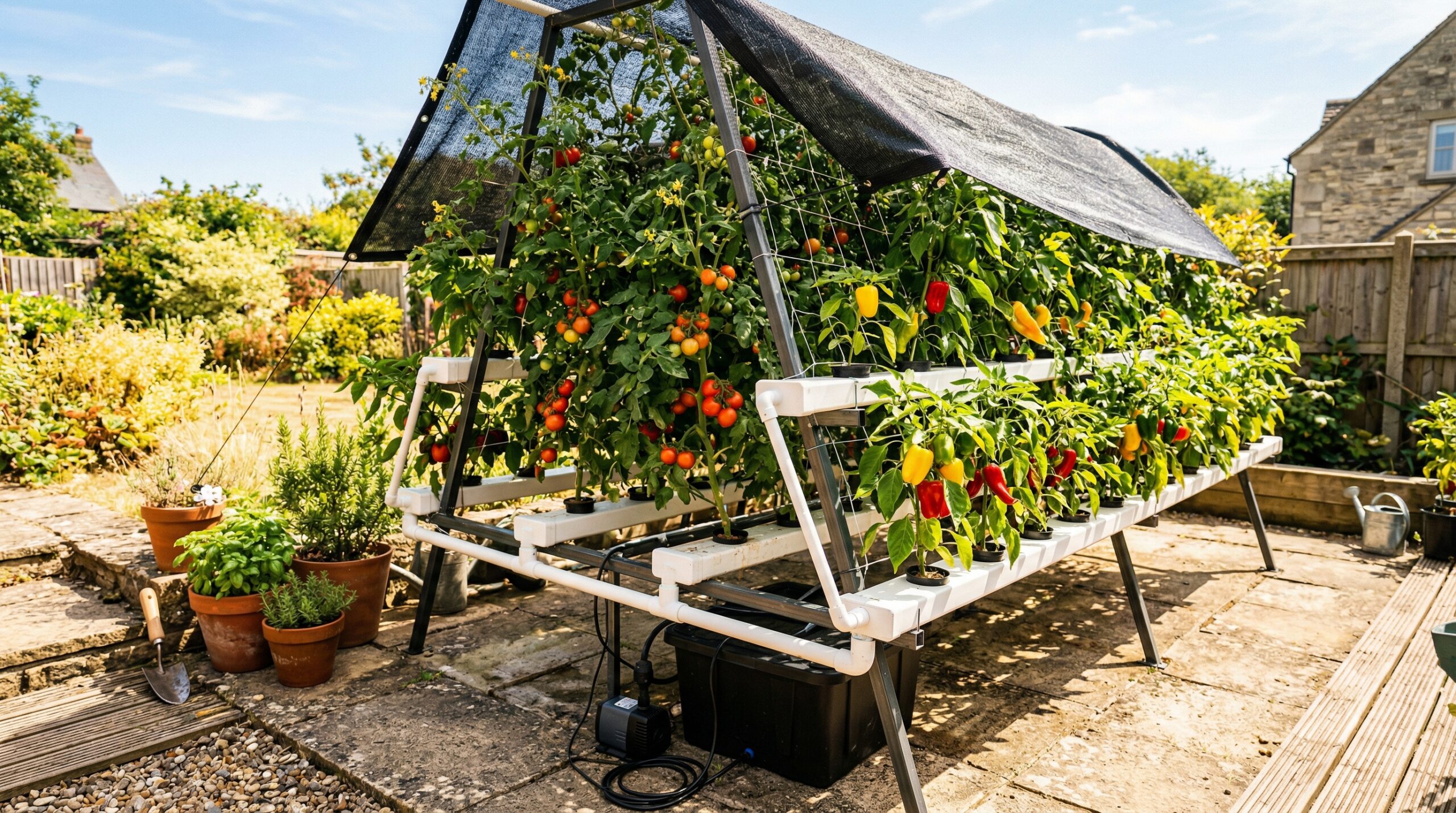
Tomatoes: Use cages, stakes, or string supports. If you’re growing indeterminate varieties (the kind that keep growing and fruiting all season), you’ll need vertical string trellising or tall cages. Determinate (bush) varieties stay smaller and need less support, making them better for compact spaces.
Cucumbers: They vine. Give them a trellis or netting to climb, and they’ll use every inch of it. Growing cucumbers vertically saves space and improves air circulation, which reduces disease.
Peppers: Shorter than tomatoes, but branches can still break under the weight of fruit. A simple stake or small cage is enough.
Eggplants: Similar to peppers. Support the main stem and any heavy-fruiting branches.
Set up your support structure before the plant needs it. By the time a tomato plant is toppling over, it’s already too late to install a cage without damaging roots or branches.
Growing in hot climates: what changes

If you’re growing in a warm climate (USDA zones 9 and above, or anywhere with summers regularly exceeding 90F/32C), fruiting vegetables in hydroponics come with a specific set of advantages and challenges.
The advantages are real. Long growing seasons, abundant sunlight, and warm nights that fruiting plants love. In places like Southern California, Texas, Florida, Arizona, or Mediterranean climates, you can grow tomatoes and peppers outdoors almost year-round with a hydroponic system.
But heat creates problems too. When nutrient solution temperature rises above 75F (24C), dissolved oxygen drops and root pathogens thrive. In a hot climate, your reservoir can easily reach 80F or higher on a summer afternoon.
What to do about it:
Keep your reservoir shaded. Direct sun on the tank is the main cause of overheating. A simple shade cover or reflective wrap makes a big difference.
Use a larger reservoir. More water volume means slower temperature swings. A 10-gallon reservoir heats up much faster than a 40-gallon one.
Top up with cool water during heat spikes. If you notice water temp climbing, adding fresh, cool water brings it back down.
Consider growing during the shoulder seasons. In very hot climates, spring and fall are often more productive for fruiting crops than peak summer. Tomatoes actually stop setting fruit when temperatures stay above 95F (35C) for extended periods, even if everything else is perfect. Peppers are more heat-tolerant but still slow down above 90F.
If you grow through summer in a hot climate, cherry tomatoes and heat-tolerant pepper varieties handle the stress better than large beefsteak tomatoes, which tend to drop their flowers in extreme heat.
The timeline is longer. Be ready for that.
Leafy greens give you a harvest in 3 to 5 weeks. Fruiting vegetables take 8 to 14 weeks from transplant to first ripe fruit, depending on the crop and variety.
Here’s a rough timeline for the most common fruiting crops:
Cherry tomatoes: 8 to 10 weeks from transplant to first ripe fruit. Production continues for months.
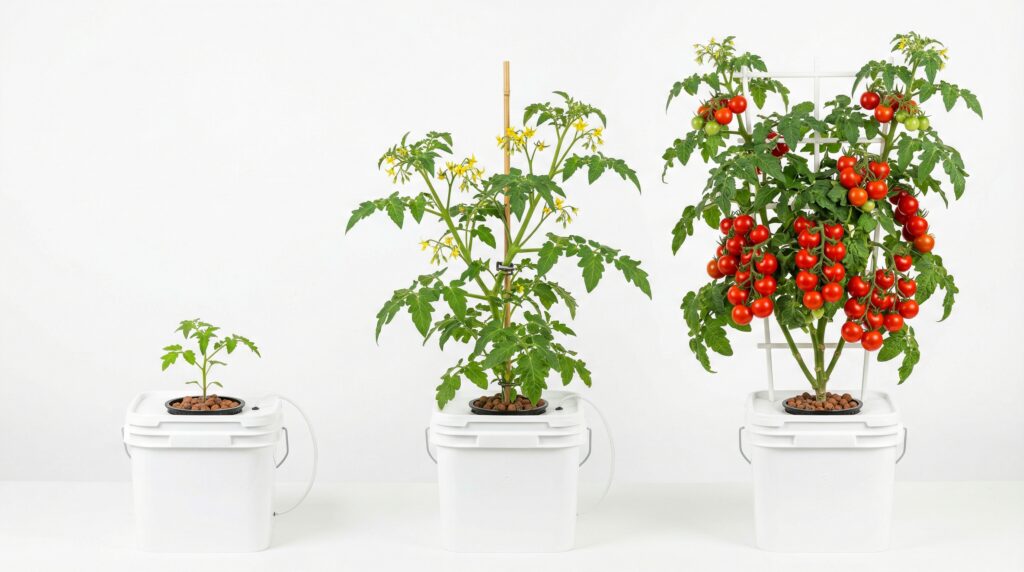
Large tomatoes (beefsteak, heirloom): 10 to 14 weeks. Slower to start, but the fruit is worth the wait.
Peppers (sweet and hot): 8 to 12 weeks for sweet peppers, sometimes longer for hot varieties. Peppers are slower starters but produce steadily once they get going.
Cucumbers: 6 to 8 weeks. One of the faster fruiting crops. Once they start producing, you’ll have more cucumbers than you expect.
Eggplants: 10 to 14 weeks. The slowest of the group, but surprisingly prolific once mature.
Strawberries: 6 to 10 weeks from transplant to first fruit, depending on variety. Production comes in waves.
Expect a few quiet weeks where nothing visible happens above the surface. The plant is building its root system and internal structure. Once the first small green fruit appears, production accelerates quickly.
A few more things worth knowing

Pruning matters, above and below. Tomatoes in particular benefit from pruning suckers, the small shoots that grow in the V between the main stem and a branch. Removing them directs the plant’s energy toward fruit production instead of more leaf growth. Peppers and eggplants also produce better when you remove the first few flowers, forcing the plant to build a stronger structure before it starts fruiting.
But don’t forget what’s happening underground. Fruiting plants develop thick root systems that can block channels and restrict water flow over time. Every two to four weeks, lift your plant (if your system has removable lids) and check the roots. If they’re tangled, dense, and blocking the channel, trim the excess with clean scissors. This keeps water flowing and encourages fresh, healthy root growth. It takes two minutes and prevents the kind of slow decline that makes growers think something mysterious is wrong with their plants.
Air circulation isn’t optional. Fruiting plants are denser and bushier than greens, which means more humidity around the leaves and more potential for fungal issues. A small fan providing gentle airflow around the plants prevents most problems before they start.
Start with cherry tomatoes and small peppers. If this is your first time growing fruiting crops hydroponically, start with cherry tomatoes and small sweet or hot peppers. They’re more forgiving, produce faster, and give you plenty of fruit to enjoy while you learn the rhythm of a longer-season crop.
Don’t mix leafy greens and fruiting plants in the same reservoir. Their nutrient needs are different enough that one group will always be compromised. Leafy greens want more nitrogen, fruiting plants want more phosphorus and potassium. If you want both, run them on separate systems or separate reservoirs.
Mistakes that cost you a season
These are the ones that waste months of growing time. Avoid them from the start:
Planting in a system that’s too small for the roots. If your channels are narrow or your containers are shallow, fruiting plants will outgrow them within weeks. Root blockages, leaks, and nutrient starvation follow. Make sure your system can handle large, long-season root systems before you plant.
Guessing nutrient amounts. “A little bit more” is not a measurement. Follow the instructions on your nutrient bottle, or better yet, use an EC meter. Fruiting plants need increasing nutrient strength as they mature, and getting this wrong (too much or too little) is the most common cause of disappointing harvests.
Putting the system where there isn’t enough sun. Minimum five hours of direct sunlight per day for outdoor systems. Less than that, and your plants will grow tall and weak with few flowers and even fewer fruit. If your space doesn’t get enough sun, supplement with grow lights or choose a different location.
Ignoring the plants for weeks. Fruiting vegetables aren’t set-and-forget. They need a quick check every few days: water level, leaf color, new growth direction, branches that need support, pests that need attention. This doesn’t have to be a chore. Five minutes with your plants every few days is all it takes, and most growers find it’s the part they enjoy most.
The payoff
At some point, every grower who sticks with fruiting crops has the same experience: picking a sun-warm tomato from a plant they grew without soil, slicing it, and tasting something the grocery store has never come close to delivering.
Fruiting vegetables are more demanding than leafy greens. They take longer, they ask more questions of you as a grower, and they don’t forgive neglect as easily. But they produce food that’s worth every extra minute of attention.
Start with one crop. Learn its rhythm. Then expand from there.